

Salary TDS Tax Year 2026-27: New Tax Slabs, Forms and Rules

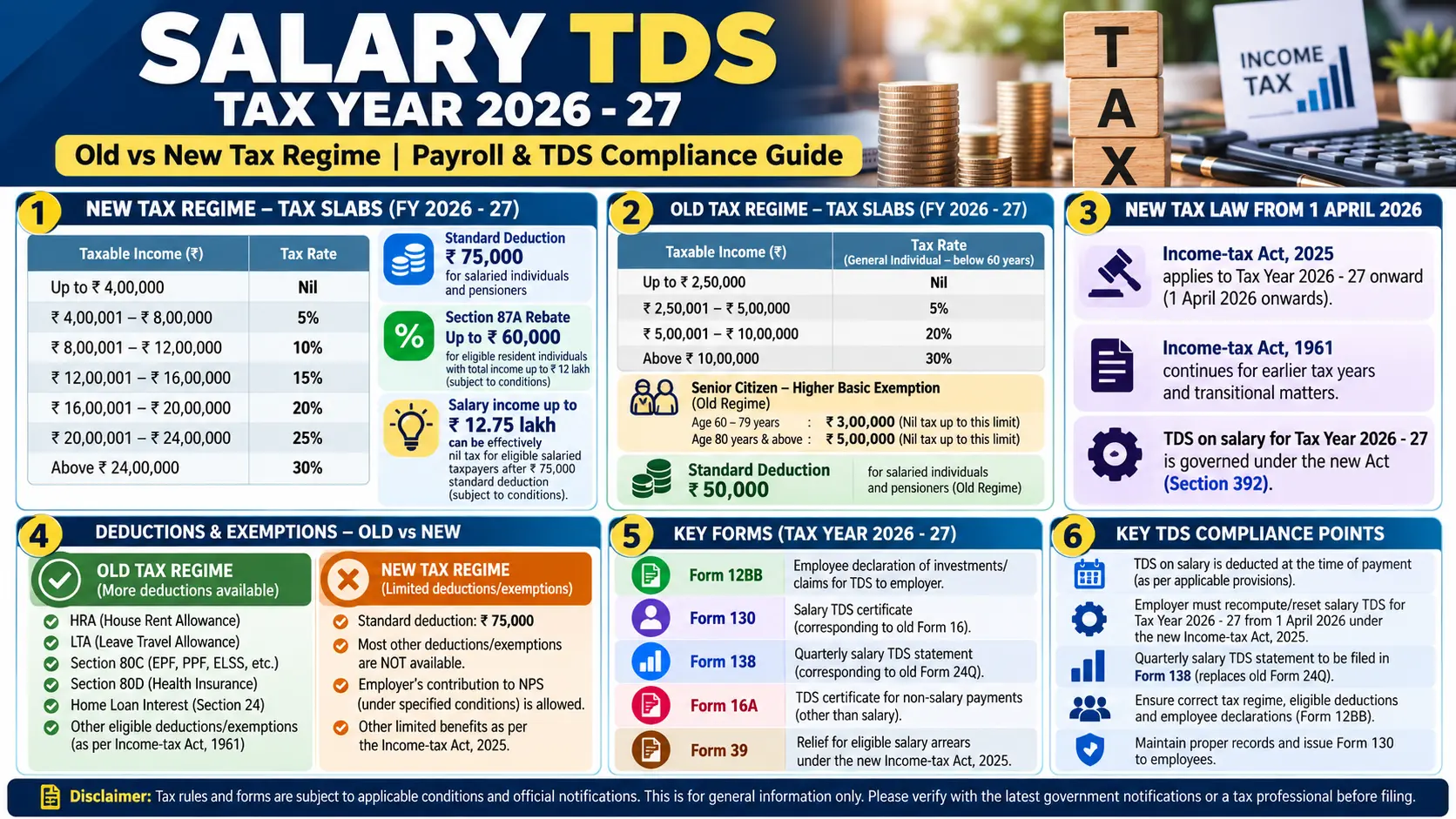
Salary TDS rules are changing with the implementation of the Income-tax Act, 2025 for Tax Year 2026-27. Employees, employers and payroll teams need to understand the new tax slabs, deductions and TDS forms applicable from April 2026.
Salary TDS Tax Year 2026-27: What Has Changed?
The salary tax and TDS framework has important changes for Tax Year 2026-27 following the implementation of the Income-tax Act, 2025 from April 1, 2026.
The new framework affects salary taxation, TDS calculation, payroll compliance and the forms used by employees and employers.
New Tax Regime: Salary Tax Slabs 2026-27
Under the new tax regime, the applicable tax slabs for Tax Year 2026-27 are:
| Taxable Income | Tax Rate |
|---|---|
| Up to ₹4,00,000 | Nil |
| ₹4,00,001 – ₹8,00,000 | 5% |
| ₹8,00,001 – ₹12,00,000 | 10% |
| ₹12,00,001 – ₹16,00,000 | 15% |
| ₹16,00,001 – ₹20,00,000 | 20% |
| ₹20,00,001 – ₹24,00,000 | 25% |
| Above ₹24,00,000 | 30% |
For eligible salaried taxpayers, the ₹75,000 standard deduction can mean that gross salary of up to ₹12.75 lakh may result in effectively zero tax under the applicable conditions and rebate provisions.
Old Tax Regime: Salary Tax Slabs
For a general individual below 60 years, the old tax regime has the following basic slab structure:
| Taxable Income | Tax Rate |
|---|---|
| Up to ₹2,50,000 | Nil |
| ₹2,50,001 – ₹5,00,000 | 5% |
| ₹5,00,001 – ₹10,00,000 | 20% |
| Above ₹10,00,000 | 30% |
Senior Citizen Tax Limits Under Old Regime
| Age Group | Basic Exemption Limit |
|---|---|
| 60–79 years | ₹3 lakh |
| 80 years and above | ₹5 lakh |
Old vs New Tax Regime: Deductions
| Old Tax Regime | New Tax Regime |
|---|---|
| HRA, subject to applicable conditions | Most traditional exemptions are not available |
| LTA, subject to applicable conditions | ₹75,000 standard deduction |
| Section 80C eligible investments | Specified deductions may be available |
| Section 80D health insurance deduction | Limited eligible deductions |
| Eligible home loan interest benefits | Benefits subject to applicable conditions |
Important TDS Forms for Tax Year 2026-27
| Form | Purpose |
|---|---|
| Form 12BB | Employee declaration of eligible investments and claims for salary TDS. |
| Form 130 | Salary TDS certificate corresponding to the earlier Form 16. |
| Form 138 | Quarterly salary TDS statement corresponding to the earlier Form 24Q. |
| Form 16A | TDS certificate for applicable non-salary payments. |
| Form 39 | Relief relating to eligible salary arrears under the applicable new framework. |
Income-tax Act 2025 and Salary TDS
From 1 April 2026, the Income-tax Act, 2025 applies to the new tax years. Salary TDS for Tax Year 2026-27 follows the applicable provisions of the new framework.
What Employees Should Check
- Check the selected tax regime.
- Verify the applicable standard deduction.
- Submit eligible investment and deduction declarations.
- Check monthly TDS deductions.
- Verify salary TDS records.
- Check the TDS certificate issued by the employer.
What Employers and Payroll Teams Should Check
- Update payroll systems for Tax Year 2026-27.
- Apply the employee's selected tax regime correctly.
- Calculate annual taxable salary accurately.
- Apply eligible deductions and exemptions.
- Deduct salary TDS correctly.
- File the applicable quarterly TDS statement.
- Issue the appropriate salary TDS certificate.
- Maintain accurate payroll records.
Frequently Asked Questions
What is the new tax-free slab under the new tax regime?
The new tax regime starts with a Nil tax slab up to ₹4 lakh. Eligible resident individuals may also claim the applicable Section 87A rebate, subject to the prescribed conditions.
What is the standard deduction under the new tax regime?
The applicable standard deduction for eligible salaried individuals and pensioners under the new regime is ₹75,000.
What is Form 130?
Form 130 is the salary TDS certificate corresponding to the earlier Form 16 under the applicable new framework.
What is Form 138?
Form 138 is the quarterly salary TDS statement corresponding to the earlier Form 24Q.
When did the new Income-tax Act framework start?
The Income-tax Act, 2025 framework applies from 1 April 2026 for the new tax years.
Income Tax Calculator (FY 2026-27 / AY 2027-28)
Compare your tax liability under Section 115BAC New Tax Regime vs Old Tax Regime with standard deduction & Section 87A rebate rules.
- Standard Deduction of ₹75,000 for salaried individuals under New Regime
- Tax Rebate Section 87A applies for net taxable income up to ₹7,000,000
- Calculations assume baseline individual tax rates without surcharge or cess variations