

Insurance
Digital Rupee (e₹): Uses, Benefits and Future in India | FinSetu India

FinSetu Editorial Team
Finance & Insurance Editorial Desk Published: Recent 12 min read
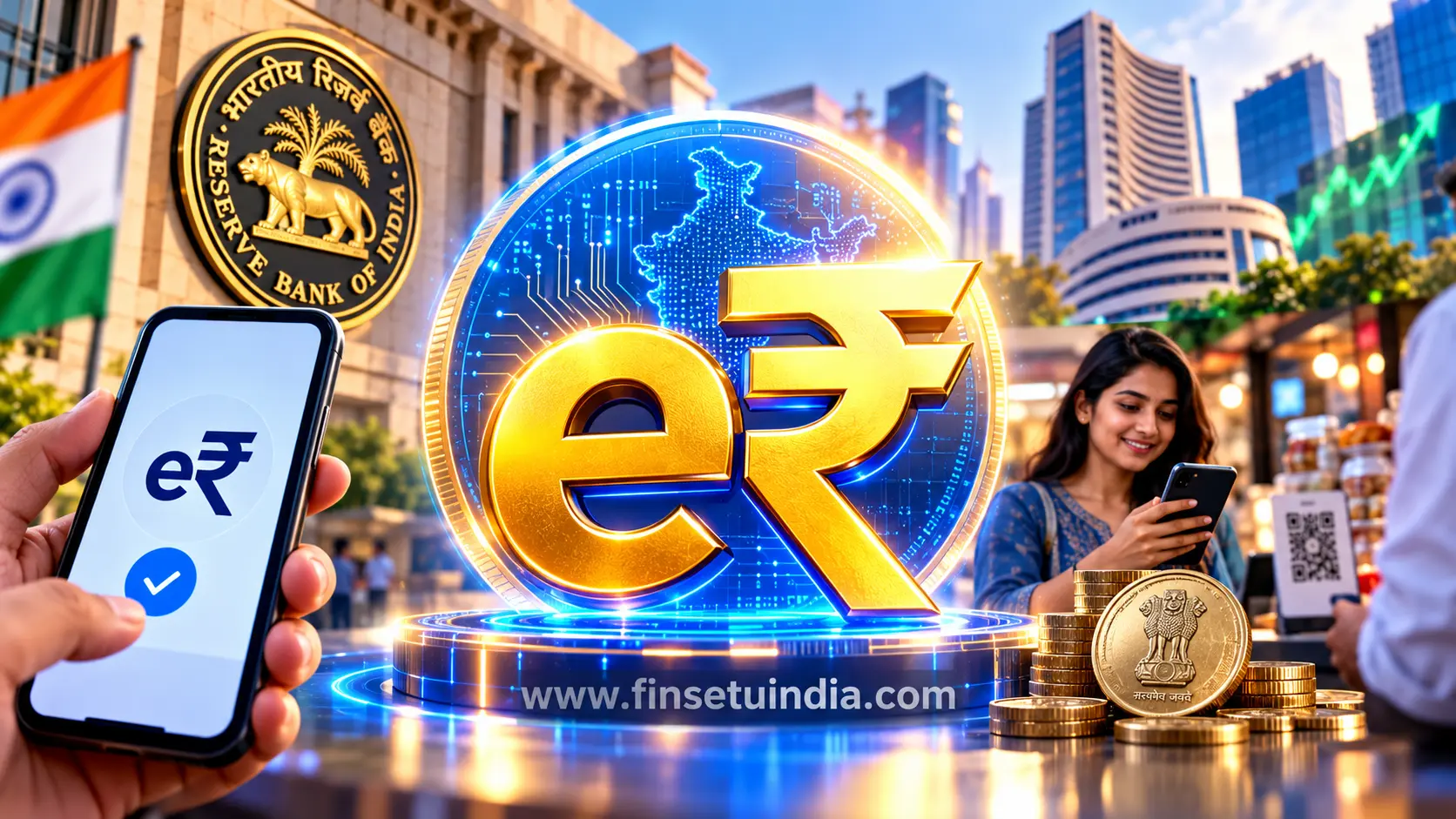
Digital Rupee (e₹): Uses, Benefits and Future in India
Digital Rupee (e₹) is India's Central Bank Digital Currency (CBDC), issued by the Reserve Bank of India (RBI). It represents the Indian rupee in digital form and is designed to provide another way to hold and use money alongside physical cash and existing digital payment methods. As India continues to expand its digital payment ecosystem, the Digital Rupee could play an important role in retail payments, merchant transactions and financial market settlements. But how does e₹ work? Is it different from UPI? What are its benefits, and what could its future look like? In this guide, FinSetu India explains Digital Rupee uses in India, its key features, practical applications, limitations and future potential in simple language.Digital Rupee: Key Highlights
- Digital Rupee is India's Central Bank Digital Currency, also known as e₹.
- It is issued by the Reserve Bank of India.
- It is a digital form of the Indian rupee and is legal tender.
- Users can hold e₹ in a digital wallet offered by participating providers.
- Retail use cases include person-to-person and person-to-merchant payments.
- e₹ is different from UPI, although a Digital Rupee wallet can support payments using UPI QR codes.
- Digital Rupee pilots are exploring retail, wholesale, programmability and offline functionality.
What Is Digital Rupee (e₹)?
The Digital Rupee, represented by the symbol e₹, is the digital form of India's sovereign currency. Unlike a private cryptocurrency, it is issued by the Reserve Bank of India and represents a direct liability of the central bank. Digital Rupee is designed to provide cash-like features in digital form. Instead of carrying physical notes and coins, users can hold digital rupee units in an eligible wallet and use them for supported transactions. The RBI has been testing Digital Rupee through pilot programmes in two broad segments:- Retail CBDC (e₹-R): Intended for individuals and businesses for everyday payments and other retail transactions.
- Wholesale CBDC (e₹-W): Designed for eligible financial institutions and market participants, including certain securities and interbank settlement use cases.
How Does Digital Rupee Work?
Digital Rupee works through a digital wallet provided by a participating bank or non-bank provider. Eligible users can download the provider's app, complete the required onboarding process and use the wallet to hold or transact in e₹. A typical transaction may follow these steps:- Check whether your bank or another authorised participating provider offers a Digital Rupee wallet.
- Download the official app from the provider or the relevant app store listing.
- Complete registration and any required verification.
- Load Digital Rupee into your wallet through the supported process.
- Send e₹ to another eligible user or make a supported merchant payment.
- Check the transaction confirmation and wallet balance.
Important: Digital Rupee wallet availability is not necessarily universal across every bank or customer. Use the official app of a participating provider and verify its current eligibility, features and instructions.
Digital Rupee Uses in India
The practical uses of Digital Rupee depend on the wallet features, participating institutions and the development of the CBDC ecosystem. The main potential and existing use cases include the following.1. Person-to-Person Payments
Users with compatible wallets can send Digital Rupee to other eligible users. This provides another digital option for transferring money between individuals, subject to the wallet's available features.2. Merchant Payments
Digital Rupee can be used for supported purchases from participating merchants. Depending on the merchant's setup, customers may scan a CBDC QR code or a compatible UPI QR code through the Digital Rupee wallet.3. Everyday Spending
Digital Rupee is intended to support retail transactions in a way that resembles the use of physical cash, but through a digital wallet. Its usefulness for daily shopping depends on local merchant acceptance and the user's wallet access.4. Programmable Payments
Programmability can enable payments to follow predefined conditions. For example, a permitted programme could restrict the purpose or circumstances in which funds are used. Such applications depend on the particular design and rules of the programme; programmability does not mean that every Digital Rupee balance is automatically restricted.5. Offline Payment Experiments
Offline functionality is an area being explored in CBDC development. It could be useful in locations with limited connectivity. However, users should not assume that every e₹ wallet supports offline transactions or that every offline payment method is available everywhere.6. Wholesale Financial Settlements
Wholesale CBDC can support settlement use cases involving financial institutions. RBI's documented pilot use cases include the settlement of secondary-market government securities transactions and interbank lending and borrowing in the call money market.Benefits of Digital Rupee
Digital Rupee offers several potential benefits for consumers, merchants and the financial system.- Central bank-issued money: e₹ is issued by the RBI and represents a liability of the central bank.
- Digital convenience: Users can hold and use currency through a compatible digital wallet instead of carrying physical notes.
- Another payment option: It adds to the payment choices already available to individuals and businesses.
- Cash-like characteristics: Digital Rupee is designed to offer features associated with physical currency, including legal-tender status.
- Potentially efficient settlement: Wholesale CBDC may help streamline certain financial market settlements and reduce settlement-related risks.
- Programmable use cases: Suitable designs may support purpose-based or condition-based payments.
- Potential for financial inclusion: Future developments could improve access to digital currency and payment options, depending on availability, affordability and usability.
Digital Rupee vs UPI: What Is the Difference?
One of the most common questions is whether Digital Rupee and UPI are the same. They are not. Digital Rupee is a form of currency, whereas UPI is a payment system that enables money transfers between linked accounts.| Feature | Digital Rupee (e₹) | UPI |
|---|---|---|
| What it is | Digital form of the rupee | A payment system |
| Underlying money | RBI-issued digital currency | Typically transfers bank-account money |
| Where value is held | In an e₹ wallet | Generally in linked bank accounts |
| How it is used | Eligible wallet transfers and supported payments | Instant payment instructions between participating accounts |
| QR payments | CBDC QR and supported UPI QR payments | UPI QR payments |
| Interest | No interest on wallet balances under RBI's stated arrangement | Depends on the underlying bank account and its terms |
Is Digital Rupee Safe?
Digital Rupee is issued by the RBI, and the central bank has described security arrangements for participating wallets. However, using a digital wallet still requires basic cybersecurity precautions.- Download the wallet only from an official provider or trusted app-store listing.
- Never share OTPs, passwords, PINs or wallet recovery details with strangers.
- Verify the recipient and payment amount before confirming a transaction.
- Keep your phone and wallet app updated.
- Contact the wallet provider through its official customer-support channel if you notice an unauthorised transaction or suspect fraud.
- Do not assume that a wallet eliminates every technology, device, privacy or fraud risk.
Limitations and Challenges of Digital Rupee
Although Digital Rupee has potential, its adoption also depends on several practical factors.- Availability: Wallet access depends on participating providers and eligibility.
- Merchant acceptance: Consumers need merchants that support the relevant payment route.
- User awareness: Many people may need clearer guidance on how e₹ differs from UPI and bank balances.
- Technology and connectivity: Wallet usability depends on supported devices, software and available features.
- Privacy and data protection: The handling of transaction information and the design of privacy safeguards remain important considerations.
- Adoption and convenience: Users will compare e₹ with payment methods they already know and use.
What Is the Future of Digital Rupee in India?
The future of Digital Rupee will depend on the outcomes of RBI's pilots, user adoption, merchant participation and the development of practical use cases. Several areas could shape its evolution.1. Wider Retail Adoption
If wallet access becomes easier and more merchants accept e₹, Digital Rupee could become a more familiar payment option for retail customers. Wider adoption will require clear benefits for both customers and merchants.2. Programmable Payments
Programmability could support carefully designed use cases in which payments are made only when specified conditions are met. Any such implementation would need appropriate safeguards, transparent terms and compliance with applicable rules.3. Offline Functionality
Further development of offline payment capabilities could make digital currency more useful in areas with unreliable connectivity. Availability will depend on the features tested and rolled out by the RBI and participating providers.4. Financial Market Settlements
Wholesale CBDC may help improve the efficiency of eligible financial market transactions by enabling settlement in central bank money. Results from pilot use cases will help determine where these arrangements offer practical value.5. Integration With India's Digital Payment Ecosystem
Compatibility with existing payment infrastructure, including supported QR codes, may reduce friction for customers and merchants. The aim is not necessarily to replace every current payment method but to add another option where it is useful. Important perspective: These are potential directions, not guarantees of future policy or universal availability. The pace of development will depend on official decisions, technical testing, adoption and regulatory considerations.How to Start Using Digital Rupee
If you want to explore e₹, follow these basic steps:- Check the current list of participating banks and non-bank providers on the official RBI CBDC information page.
- Confirm whether your provider offers a Digital Rupee wallet and whether you are eligible.
- Install the provider's official app and complete the onboarding process.
- Read the wallet's instructions for loading, holding, sending and redeeming e₹.
- Start with a small transaction only after checking the recipient, amount and payment route.
- Keep the provider's official support details available in case you need help.
Frequently Asked Questions (FAQs)
1. What is Digital Rupee in India?
Digital Rupee, or e₹, is India's Central Bank Digital Currency issued by the Reserve Bank of India. It is the digital form of the Indian rupee.2. Is Digital Rupee the same as UPI?
No. Digital Rupee is a form of currency, while UPI is a payment system. An e₹ wallet can support payments using compatible UPI QR codes, but the underlying transaction route can differ.3. Is Digital Rupee legal tender?
Yes. The RBI describes Digital Rupee as legal tender and a liability of the central bank, subject to the applicable legal framework.4. Does Digital Rupee earn interest?
No interest is payable on e₹ wallet balances under the RBI's stated arrangement. Digital Rupee is designed as currency rather than an interest-bearing deposit.5. Can I use Digital Rupee without a bank account?
RBI's published FAQ states that retail e₹ wallet onboarding is currently linked to savings accounts, while alternative onboarding models have been explored. Check the latest eligibility requirements with participating providers.6. Can Digital Rupee be used for offline payments?
Offline functionality has been explored as part of CBDC development. Do not assume that every wallet supports offline payments; check the current features offered by your provider.7. Is Digital Rupee a cryptocurrency?
No. Digital Rupee is issued by the RBI as sovereign currency. It is different from privately issued cryptocurrencies, which are not the same as central bank-issued legal tender.8. Where can I get the official Digital Rupee app?
Check the RBI's official CBDC information and the current list of participating providers. Download the app only through the official provider or a trusted app-store listing.Conclusion: Is Digital Rupee Important for India's Financial Future?
Digital Rupee is an important development in India's digital currency ecosystem. As an RBI-issued digital form of the rupee, it offers an additional way to hold and use money and opens possibilities for retail payments, programmable applications, offline use cases and wholesale financial settlements. However, Digital Rupee is not simply another name for UPI, and it is not guaranteed to replace cash or existing payment methods. Its future will depend on practical benefits, ease of use, security, merchant acceptance and the results of ongoing development. For more explainers on digital payments, banking, insurance, investments and personal finance, visit FinSetu India — One Platform for Every Financial Decision.Disclaimer: This article is for educational and informational purposes only. Digital Rupee features, eligibility, wallet availability and pilot arrangements may change. Always verify current details through official RBI publications and your participating provider. This article is not financial, legal or investment advice.
Official Sources
Interactive Wealth Growth Tool
Mutual Fund SIP Compounding Calculator
Calculate future wealth accumulation through monthly Systematic Investment Plans (SIP), CAGR growth rate, and rupee cost averaging.
Transparent Methodology & Inputs
- Formula: M = P × ({[1 + i]^n - 1} / i) × (1 + i)
- Assumed annual rate of return (e.g. 12% CAGR) is illustrative based on historical index trends
- Does not account for exit loads or short-term capital gains tax (STCG) variations
Limitation: Mutual fund investments are subject to market risks. Historical return estimates are not guaranteed future outcomes.Official Citation: Association of Mutual Funds in India (AMFI) Guidelines
#digitalrupee#erupee#digitalrupeeindia#rbi#cbdc#digitalpayments#upi#fintechindia#digitalindia#futureofmoney#personalfinance#financialliteracy#finsetuindia