

Loans & EMI
Bike, Car & Home Loans: Compare Interest Rates, Hidden Charges & Fees | FinSetu India

FinSetu Editorial Team
Finance & Insurance Editorial Desk Published: Recent 14 min read
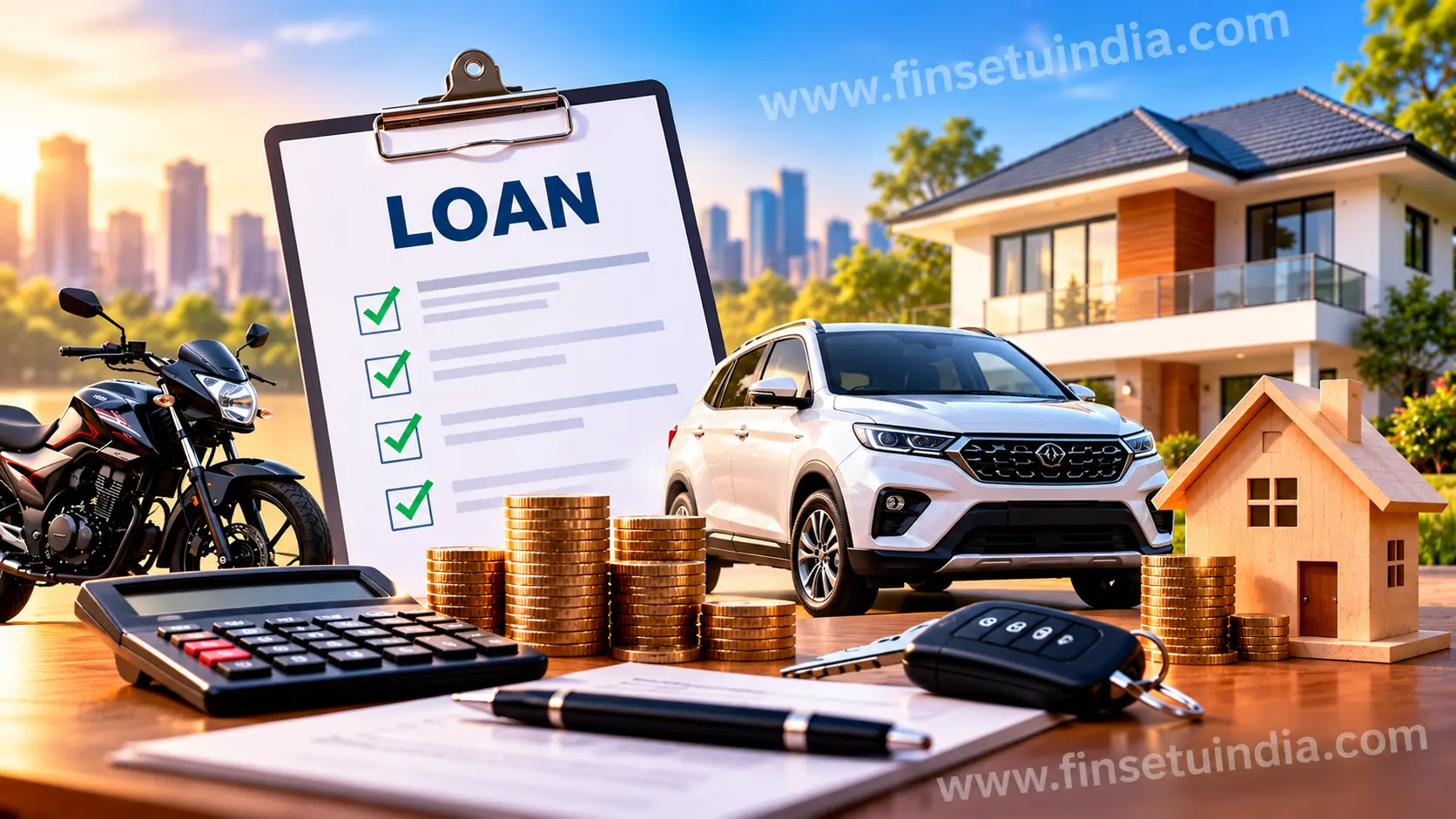
Bike, Car and Home Loans: Interest Rates, Hidden Charges and Ways to Save on Fees
Taking a loan to buy a bike, car or home is common, but choosing a loan based only on a low interest rate or affordable EMI can prove costly. Processing fees, documentation charges, insurance premiums, legal verification, valuation fees and other applicable charges can increase the total cost of borrowing. That is why understanding the precautions to take before getting a loan is essential. The right loan should fit your budget, offer transparent terms and have a competitive total cost after accounting for interest and all applicable charges. In this guide, FinSetu India explains how to compare bike, car and home loans, identify hidden charges, negotiate processing fees and reduce your overall borrowing costs.8 Things to Check Before Taking a Loan
- Compare the total loan cost, not just the interest rate.
- Include the down payment and upfront expenses in your budget.
- Ask for a written list of processing fees and other charges.
- Understand the Key Facts Statement (KFS) and Annual Percentage Rate (APR), where applicable.
- Know the difference between fixed and floating interest rates.
- Calculate how extending the loan tenure affects total interest.
- Distinguish between mandatory and optional insurance products.
- Never sign documents or transfer money without understanding the terms and verifying the recipient.
Why Is It Important to Be Careful When Taking a Loan?
A loan is a financial commitment that may continue for months or years. If you borrow without comparing the terms carefully, additional fees, a longer repayment period or changing interest rates could put unnecessary pressure on your finances. For example, two lenders may offer similar interest rates, but one may charge a higher processing fee or additional documentation expenses. Instead of relying on an advertised rate, compare written offers and calculate the total amount you will pay. The Reserve Bank of India (RBI) has issued directions concerning transparency in lending costs and the disclosure of important loan terms. For eligible retail term loans, a Key Facts Statement can help borrowers understand the applicable interest, charges and repayment terms.Bike Loan vs Car Loan vs Home Loan
These loans differ in purpose, tenure, security requirements and additional expenses. Understanding these differences can help you choose the right financing option.| Loan Type | Main Purpose | Costs to Check |
|---|---|---|
| Bike Loan | Purchasing a new or eligible two-wheeler | Processing fees, down payment, vehicle insurance, documentation and other applicable charges |
| Car Loan | Purchasing a new or used car | Processing fees, down payment, insurance and applicable valuation or inspection charges |
| Home Loan | Buying or constructing an eligible residential property | Processing fees, legal verification, technical valuation, stamp duty, registration and other applicable expenses |
1. How to Compare Interest Rates
Interest rates are an important part of borrowing costs, but the loan with the lowest advertised rate is not always the cheapest option. Consider the following factors before making a decision.- Actual offered rate: The advertised starting rate may differ from the rate offered to you after the lender evaluates your profile.
- Fixed or floating rate: A fixed rate follows the agreed terms, while a floating rate may change and affect your EMI or loan tenure.
- APR: Where applicable, the Annual Percentage Rate reflects the annual cost of borrowing, including interest and specified charges under the relevant rules.
- Benchmark and reset terms: For floating-rate home loans, understand the benchmark and how frequently the rate may change.
- Loan tenure: A longer tenure may reduce monthly payments but increase total interest.
2. A Lower EMI Does Not Always Mean a Cheaper Loan
Many borrowers choose a longer tenure because it reduces their monthly EMI. While this may make monthly payments more manageable, it can increase the total interest paid over the life of the loan. Consider the following illustrative example. Assume a loan of ₹5 lakh at an annual interest rate of 10%, with the rate remaining unchanged throughout the tenure.| Loan Tenure | Approx. Monthly EMI | Approx. Total Interest |
|---|---|---|
| 3 years | ₹16,134 | Around ₹80,800 |
| 5 years | ₹10,624 | Around ₹1.37 lakh |
3. What Are Hidden Loan Charges?
Not every additional fee is improper or unlawful. The concern arises when charges are not clearly disclosed, their purpose is unclear or the borrower is asked to pay without adequate information. Request a written fee schedule before accepting the loan.| Charge | What to Check |
|---|---|
| Processing Fee | What is the amount or percentage? Is GST included, and when is it payable? |
| Documentation Charges | Which service does the fee cover, and is it charged separately? |
| Legal and Valuation Fees | For home loans, what are the costs of legal checks and property valuation? |
| Insurance Premium | What policy is being offered? Is it optional, and are alternatives available? |
| Late Payment Charges | What charges apply if you miss a payment, and how are they calculated? |
| Foreclosure or Part-Payment Charges | What conditions apply if you repay early or make an additional principal payment? |
| Rate Conversion Charges | Is a fee charged to switch between eligible interest-rate options? |
| Other Service Charges | Are there charges for statements, document copies or other services? |
4. How to Negotiate Processing Fees and File Charges
You may be able to negotiate processing fees or other upfront charges. Some banks and NBFCs offer discounts or fee waivers under specific schemes, but these benefits are not guaranteed for every borrower.- Get at least three offers: Compare your existing bank with other banks and suitable NBFCs.
- Compare the actual fee amount: Check the amount in rupees, not just the percentage, and confirm applicable taxes.
- Ask for a waiver: Ask whether processing, documentation or other eligible fees can be reduced or waived.
- Discuss your banking relationship: Existing customers or salary-account holders can ask about available customer offers, without assuming a discount is guaranteed.
- Read promotional conditions: Check whether a fee waiver comes with a higher interest rate or other charges.
- Confirm refund terms in writing: Ask which fees are refundable if the application is rejected or the loan is not disbursed.
- Keep payment receipts: Pay only through official channels of the lender or its authorised service provider.
Example: One lender may offer a lower interest rate but charge a higher processing fee, while another offers a slightly higher rate with lower fees. Compare total interest and all applicable charges before deciding.
5. What Are KFS and APR?
Two important terms to understand before accepting a loan are the Key Facts Statement (KFS) and Annual Percentage Rate (APR). Key Facts Statement (KFS): This is a standardised summary of important loan terms. For eligible loans, it may include the interest rate, repayment details, applicable charges and other key information. Read it carefully and ask the lender to explain anything that is unclear. Annual Percentage Rate (APR): APR helps borrowers understand the annual cost of borrowing. Under the applicable framework, it can include interest and specified charges. It is useful for comparing eligible loan offers, but you should also review the repayment schedule and other conditions. The RBI issued directions on KFS for loans and advances on 15 April 2024. Under the applicable rules, a KFS must be provided before the execution of covered retail and MSME term-loan contracts.6. Precautions Before Taking a Bike Loan
- Understand the difference between the ex-showroom price and the on-road price.
- Confirm how much will be financed after the down payment.
- Compare the interest rate, processing fee and total repayment amount.
- Check vehicle insurance costs and coverage, and ask about alternatives where applicable.
- Read the loan-tenure and early-repayment conditions.
- Do not add accessories, service packages or other products to the loan without understanding their costs.
7. Precautions Before Taking a Car Loan
- Compare offers for new and used cars separately.
- Calculate the down payment, interest rate, tenure and total interest.
- Review the cost, coverage and terms of vehicle insurance.
- For a used car, understand the valuation, vehicle condition and loan-eligibility requirements.
- Ask for separate prices for accessories, service packages and other add-on products included in the financing.
- Check part-payment and foreclosure conditions in the loan agreement.
8. Precautions Before Taking a Home Loan
Home loans often run for many years, so even a small change in the interest rate can affect the total repayment amount. Homebuyers may also face expenses that are separate from the EMI.- Fixed vs floating rate: Understand the rate type and the applicable reset conditions.
- Processing fee: Request a written fee schedule and ask about eligible discounts.
- Legal verification: Check the costs of reviewing property documents and applicable legal charges.
- Technical valuation: Ask about property valuation fees and the process involved.
- Stamp duty and registration: Budget for these separately, as costs vary by location and applicable rules.
- Part-payment: Understand the options and conditions for reducing the principal with additional payments.
- EMI changes: Ask how a floating-rate increase may affect the EMI or loan tenure.
9. Credit Score and Loan Approval
Your credit score and credit history can affect loan eligibility and, in some cases, the interest rate offered. However, a good score does not guarantee approval or the lowest available rate. Lenders may also assess your income, existing EMIs, employment or business situation, documentation and their own lending criteria. Before applying for a loan:- Review your credit report and raise a correction request if you find inaccurate information.
- Pay existing EMIs and credit card bills on time.
- Provide accurate income and employment information.
- Avoid unnecessary applications to multiple lenders in a short period.
- Choose a loan amount that fits your repayment capacity.
10. Practical Ways to Reduce Your Total Loan Cost
- Consider a higher down payment: If your emergency savings remain adequate, borrowing less can reduce interest costs.
- Choose a suitable tenure: Balance an affordable EMI with the total interest payable.
- Negotiate fees: Ask for discounts on eligible processing and other charges.
- Get written offers: Compare documented interest rates, fees and conditions rather than verbal promises.
- Avoid unnecessary add-ons: Understand the need and cost of additional services or insurance products.
- Pay EMIs on time: Late payments may attract applicable charges and affect your credit history.
- Check early-payment rules: If you expect extra funds, understand the conditions for reducing the principal.
- Review your budget annually: Account for insurance, maintenance and other recurring expenses alongside the EMI.
11. Be Careful With Digital Loan Apps and Agents
When applying online, do not rely only on an app's popularity or promises of instant approval. Verify the actual bank or RBI-regulated lender and understand which institution the app represents.- Verify the lender's legal name and official website.
- Read the loan terms, KFS, APR and applicable charges.
- Never transfer processing fees to an unknown person's personal account.
- Never share OTPs, PINs, passwords or banking login details.
- Review the app's permissions and privacy terms.
- Pause and verify the details if someone pressures you to sign or pay immediately.
12. Loan Checklist Before You Accept an Offer
Review this checklist before making your final decision:- ☐ I have checked the interest rate and whether it is fixed or floating.
- ☐ I have calculated the EMI, tenure and total repayment amount.
- ☐ I have received the applicable fees, taxes and other charges in writing.
- ☐ I have reviewed the KFS and APR information, where applicable.
- ☐ I understand late-payment, part-payment and foreclosure conditions.
- ☐ I understand the cost of insurance and other add-on products.
- ☐ I will still have enough money for essential expenses and savings after paying the EMI.
- ☐ I have read the documents and clarified my questions before agreeing.
Frequently Asked Questions (FAQs)
1. What is the most important precaution before taking a loan?
Do not look only at the interest rate or EMI. Understand the applicable charges, loan tenure, total repayment amount and early-repayment conditions.2. Can I negotiate a loan processing fee?
Some banks and NBFCs may offer a discount or waiver depending on the product, borrower profile and available offers. Ask for the final fee and conditions in writing.3. Is the loan with the lowest interest rate always the best?
No. Additional fees and loan conditions can make it more expensive overall. Compare APR where applicable, total repayment and the full terms.4. What is a Key Facts Statement (KFS)?
A KFS is a standardised summary of important loan terms. Depending on the applicable rules, it can provide information about interest, charges and repayment terms. It is useful to review before entering into a covered loan agreement.5. Is a longer loan tenure a good choice?
A longer tenure may reduce your monthly EMI but can increase total interest. Compare affordability and total borrowing costs before deciding.6. Are stamp duty and registration fees included in a home loan?
These may be separate property-purchase expenses. Their amount depends on the location and applicable rules, so include them separately in your budget.7. Is there always a charge for early loan repayment?
No. The applicable rules depend on the loan type, interest-rate structure, borrower category, agreement and current RBI regulations. Check the terms that apply to your specific loan.8. Can a good credit score help me get a lower interest rate?
A strong credit history may help you qualify for competitive offers, but approval and rates also depend on income, existing liabilities, loan type and lender criteria. 9. What should I do if I find an undisclosed loan charge? Request a written explanation and compare the charge with your application, KFS, sanction letter and loan agreement. If the issue is not resolved, contact the lender's grievance redressal officer and, if necessary, review the RBI's available complaint mechanisms.Conclusion
Before taking a bike, car or home loan, compare interest rates, EMIs, processing fees and other charges. Get written offers from multiple lenders, understand the total cost, review the KFS and APR where applicable, and confirm every fee before accepting the loan. Negotiate processing charges where possible, but do not choose a loan simply because its fees are waived. A higher interest rate or unfavourable terms may cost more over time. Choose the loan amount and tenure according to your income, regular expenses, savings and future financial responsibilities.Make Better Financial Decisions with FinSetu India
Explore practical insights on loans, banking, insurance, investments and personal finance.
Visit www.finsetuindia.comOne Platform for Every Financial Decision.
Disclaimer: This article is for general financial education and awareness only. Interest rates, fees, eligibility and loan terms vary by lender and product. Before accepting a loan, review the official documents, applicable regulations and your repayment capacity. This content does not constitute personalised financial, legal or tax advice.
Official Sources
- Reserve Bank of India — Key Facts Statement for Loans and Advances
- RBI — Lending Cost and Charge Disclosure Directions
- RBI — Digital Lending Guidelines
- Reserve Bank of India — Official Website
Published by FinSetu India | One Platform for Every Financial Decision.
Interactive Vehicle Insurance Tool
Motor Premium & NCB Rollover Calculator
Compute Own Damage (OD) premium, Third-Party (TP) statutory tariff rates, IDV depreciation, and 20–50% NCB rollover discounts.
Transparent Methodology & Inputs
- Third-Party (TP) rates follow statutory IRDAI annual tariff notification
- IDV depreciation schedule follows standard 5% to 50% vehicle age matrix
- NCB transfer benefit applies upon submission of previous year renewal policy
Limitation: Output provides educational estimates for guidance. Policy rates vary slightly by insurer add-on packages.Official Citation: IRDAI Motor Tariff & General Insurance Council Guidelines
#homeloan#carloan#bikeloan#loantips#interestrates#hiddencharges#processingfees#emicalculator#loancomparison#personalfinance#financialplanning#bankingtips#smartborrowing#finsetuindia